
Share:
Imagine you are launching a blog on a paid content platform. At first, everything is simple: you publish posts, communicate with subscribers, and test formats. As you grow, new opportunities arise: working with different audience segments, automating sales, scaling successful ideas. At this point, the platform becomes a tool for development.
If the platform supports such tasks, growth happens naturally and without unnecessary manual work. Therefore, it is important to choose with an eye to the future — to the formats and volumes you plan to achieve. In this article, we will compare two popular sites — OnlyFans and Fanvue — and tell you which one is better for your tasks.
Why choosing a platform is an important decision
Let’s consider three main criteria.
Impact on income. The platform’s commission and available monetization tools directly affect the amount that the creator receives. A difference of a few percent becomes significant even with average income and grows along with turnover.
Time spent on growth. The lack of built-in recommendations means complete dependence on external traffic. This requires constant work with social networks and increases the time needed to grow your audience and sales.
Long-term prospects. Changing platforms almost always leads to the loss of some subscribers and the need to rebuild processes. Therefore, choosing a platform is a long-term decision, not a temporary experiment.

What you need to know first about the platforms
OnlyFans and Fanvue solve the same problem — monetizing subscription-based content. Their main difference is the tools they offer creators. OnlyFans is more of a well-known and stable hosting service that is completely dependent on external traffic. Fanvue, on the other hand, strives to be a growth platform, offering internal mechanics for audience engagement and automation.
To make the right choice, let’s figure out the main things:
- how to find subscribers on each platform;
- what tools are available there;
- what you can and cannot do.
OnlyFans: maximum recognition, minimum tools
OnlyFans appeared in 2016 and quickly became the most famous platform for paid content. Even those who have never been models know the name and understand the principle: subscription, paid content, tips. It’s easier for fans to decide to subscribe when they’ve already heard of the platform. At the same time, OnlyFans is developing slowly: it’s more of a reliable hosting service for monetizing your audience than a tool for finding it.
Key features:
- Commission — 20% of all revenue: subscriptions, tips, PPV.
- Payouts — money can be withdrawn approximately one week after receipt. The transfer to the card takes from several days to two weeks, depending on the bank and the withdrawal method.
- Interface — simple, but many find it outdated. There is no advanced automation or convenient tools for working with subscribers.
- Search and recommendations — almost non-existent. Creators cannot be found through the catalog; the search model on OF only works by name. There is no recommendation system as such. The entire audience comes from outside: Instagram, TikTok, X(How to promote OF on X), Reddit.
One of the most striking examples of success on OnlyFans is Sophie Rain, a 21-year-old model from Miami. She claims to have earned over $100 million on the platform in a couple of years. Sophie runs a popular blog on Instagram (8.6 million subscribers), and her loyal audience has eagerly followed her to other pages. Read:How to promote OnlyFans on Instagram.
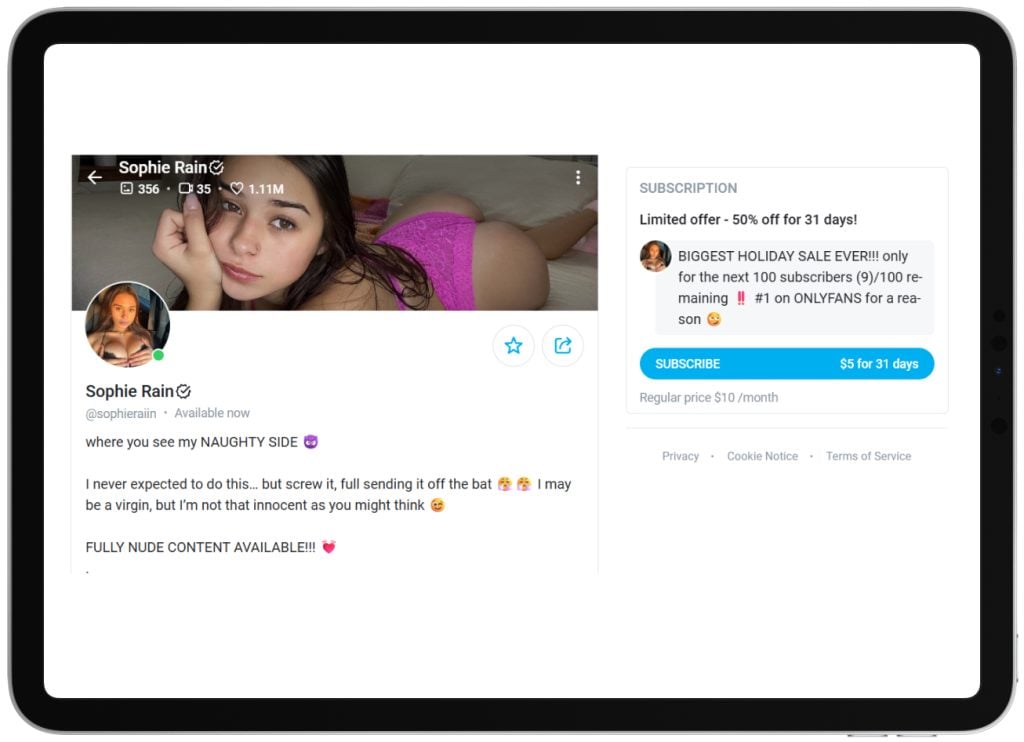
A subscription to Sophie costs only $10 per month, but her large audience provides her with a decent income
Fanvue: modern technology for growth
Fanvue appeared in 2020 as a modern alternative to OnlyFans. The platform calls itself “creator-first” — that is, created for the convenience of authors. Its main focus is on tools for growth, analytics, and automation. It is especially useful for beginners and those with few followers on social media. Fanvue has an internal search and recommendation feature, allowing creators to find part of their audience directly on the platform, not just through Instagram or TikTok.
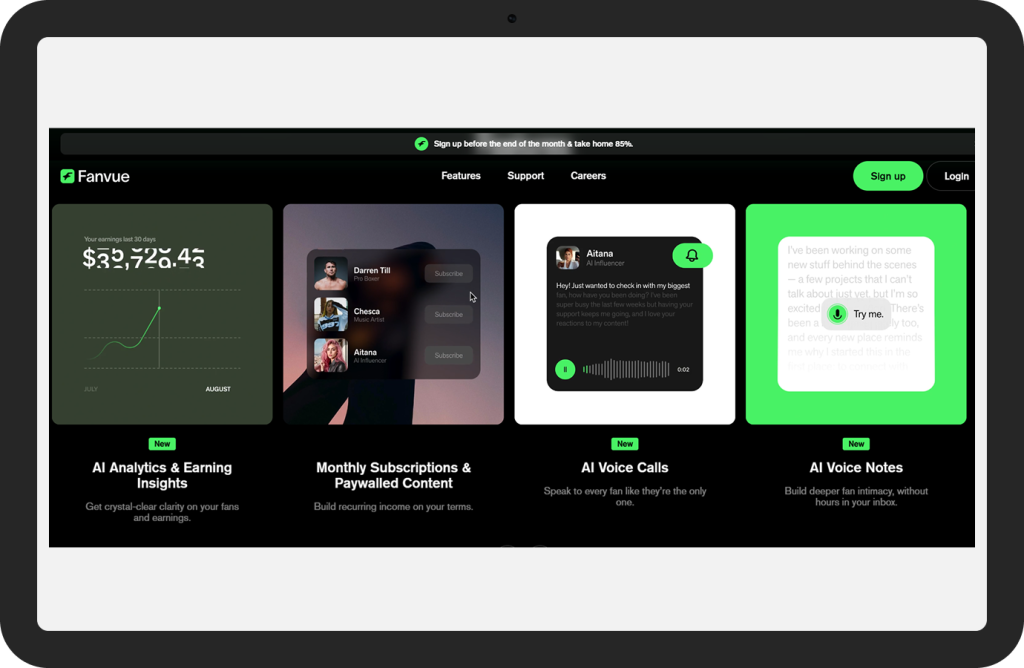
Fanvue’s main screen has a rich design and focuses on growth and monetization tools for creators
Key features:
- Commission is usually 20%. Newcomers get a bonus: the first 30 days after registration, the commission is only 15%. Then it returns to the standard 20%.
- Payments — the first time can take up to 7-10 days due to security checks. After that, it usually takes 3-7 business days, depending on the withdrawal method: bank, e-wallet, or cryptocurrency.
- Interface — modern and user-friendly. There are built-in analytics and tools for working with subscribers. Advanced automation is available through partner services.
- Discovery and AI — smart search with recommendations. The platform itself shows your profile to users who may be interested in your content. Models get an additional audience without advertising.
- Tools — post scheduling, mass mailings, message templates, auto-replies, and chatbots. Creators spend less time on routine tasks.
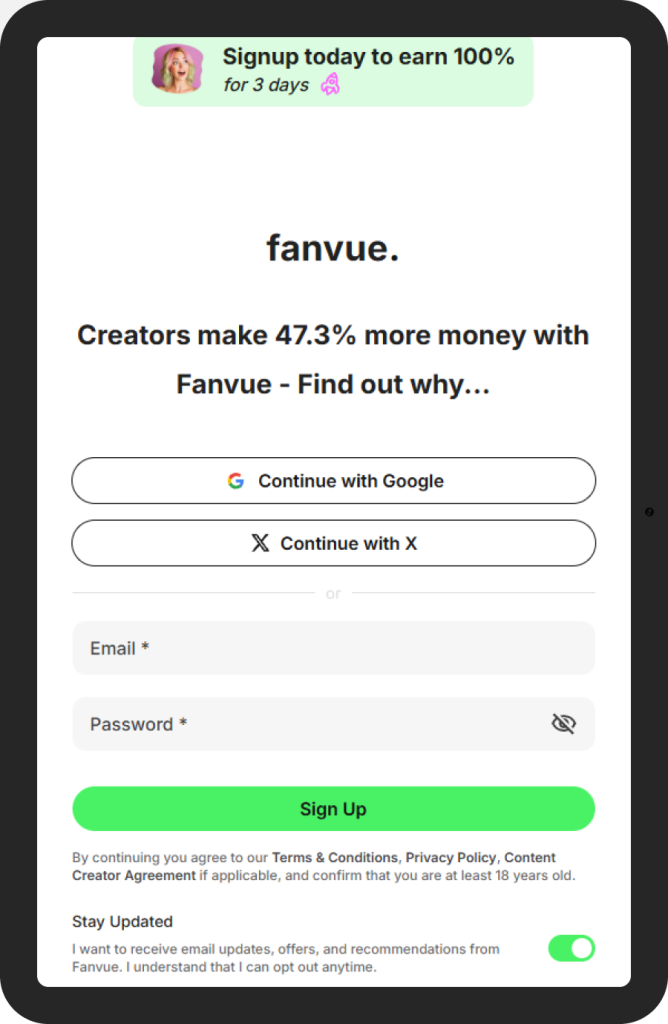
Fanvue registration screen — a visually rich interface and promotion for creators
The platform does not disclose the exact earnings of top models. But if you look at the main page in Discovery, the top spots are occupied by creators of diverse content: sports, travel, music, podcasts.
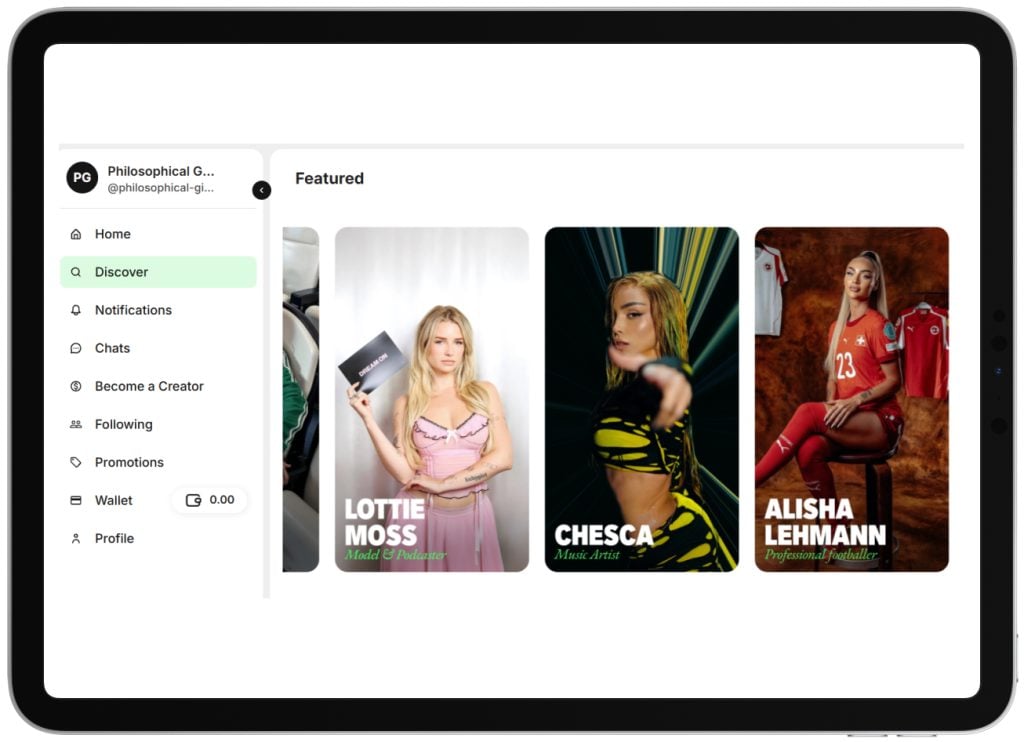
Fanvue’s search algorithms work like a recommendation feed on social networks
Direct comparison: what matters for your work
A creator’s success depends on specific tools. Here is a detailed comparison of what directly affects your income and time. To illustrate different aspects, we referred to discussions on forums. Opinions do not provide accurate estimates, but they reflect the real impressions of the authors.
- Monetization: where you will earn more
OnlyFans payments takes 20% of all income — subscriptions, tips, PPV messages on OnlyFans.
Fanvue offers a 15% commission for the first 30 days after KYC (Know Your Customer) verification. Then the commission becomes 20%.
Example. Let’s say a creator earns the same income of $5,000 per month on each platform. On OnlyFans, with a 20% commission, they receive $4,000 net ($1,000 is taken by the platform). On Fanvue, during the bonus period after KYC, when the commission is 15%, the same income would yield $4,250 ($750 is the platform commission).
The difference for that month would be $250. Further, when both OnlyFans and Fanvue take the same 20%, the net income with equal turnover evens out, and it is no longer the percentage that plays a key role, but the speed of payments.
- Payment speed
OnlyFans. Usually 7–10 days from request to actual crediting, depending on the country and method.
Fanvue. The first withdrawal after KYC can take up to 7–10 days, then payments arrive in 3–7 business days on average.
For creators who live off the platform’s income, predictable speed and no delays are important.

The subscription cost can be managed in the profile settings
- Earning tools
Both platforms support:
- monthly subscriptions;
- PPV content in private messages;
- tips;
- content bundles and discounts.
Fanvue makes it easier to build automated sales funnels through mass messages on OF scheduling, auto-replies, and templates, saving dozens of hours of manual work.
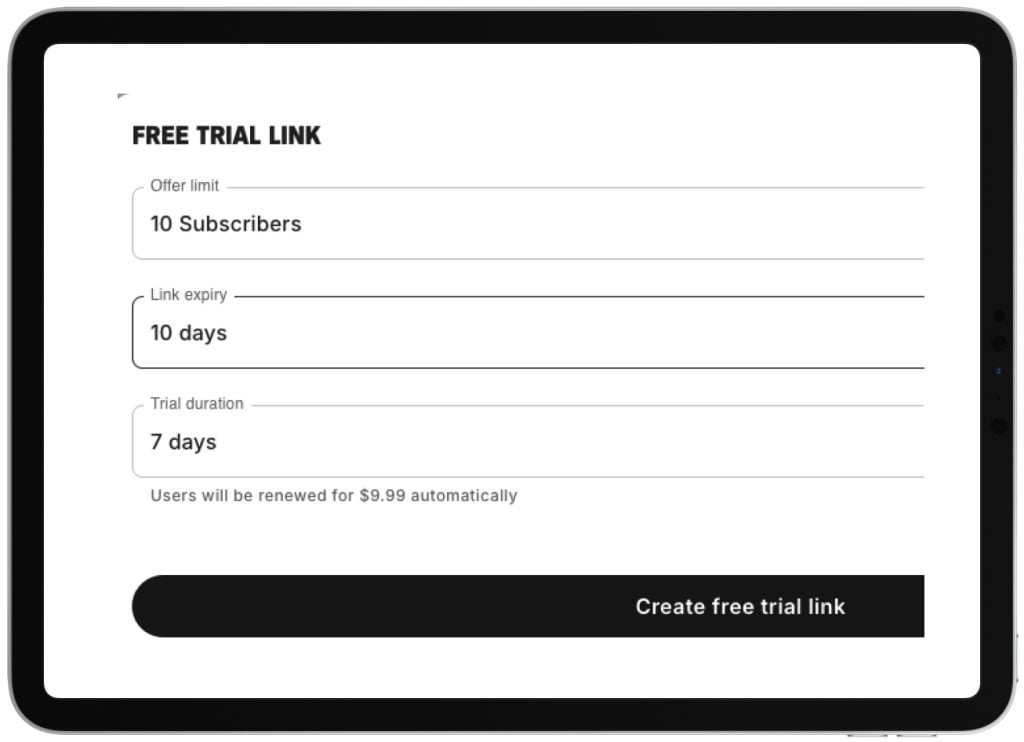
On Fanvue, you can create a link to a free trial period for a specific number of fans
- Audience growth: where it’s easier to find new fans
This is the main difference between the platforms, which determines everything else.
OnlyFans. There is no public catalog or full-fledged recommendation system. Search is limited, so real growth depends almost entirely on external traffic: users must receive your link or know your username.
Fanvue. There is a Discover section and AI-powered search: the algorithm can boost intro videos and new/well-performing accounts in search results, providing organic views within the platform. This does not negate the importance of social media, but it does make it easier to get started, even if your external audience is still small.
An additional difference between the platforms is related to moderation rules. OnlyFans does not allow AI profiles, so competition within the platform is limited to real models only. Fanvue, on the other hand, allows virtual characters, which expands the range of content and startup scenarios.
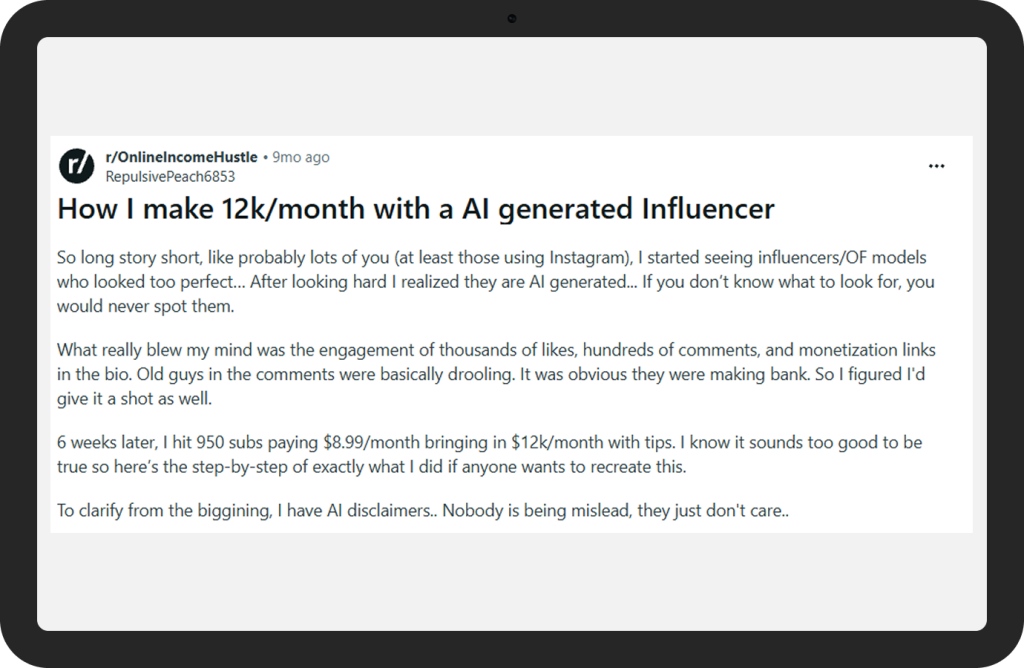
The creator managed to generate a steady income on Fanvue by combining activity and strategy for the AI model
- Analytics
OnlyFans. The platform provides only basic data — income, subscriber dynamics, number of likes. To find out more details, you need to connect third-party services or use Excel tools. Another option is to rely on agency research to understand general trends.
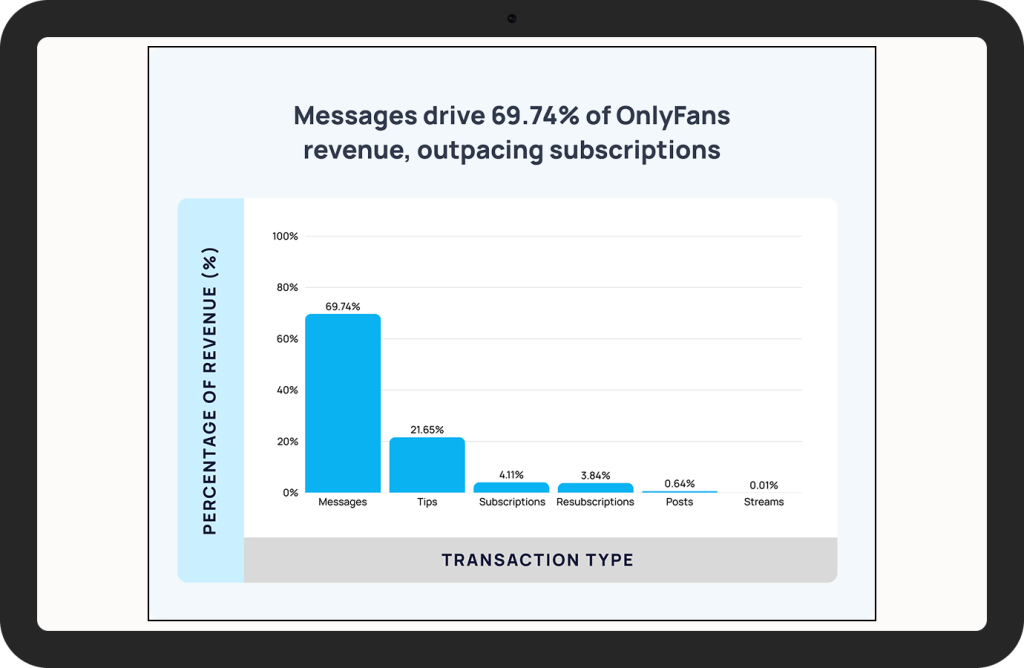
We analyzed OF paid content for 2025 and found that communicating in Direct leads to the highest income for models
Fanvue. The site offers more advanced tools. AI prompts help you understand what works best, when to post, and how to keep your subscribers’ attention.
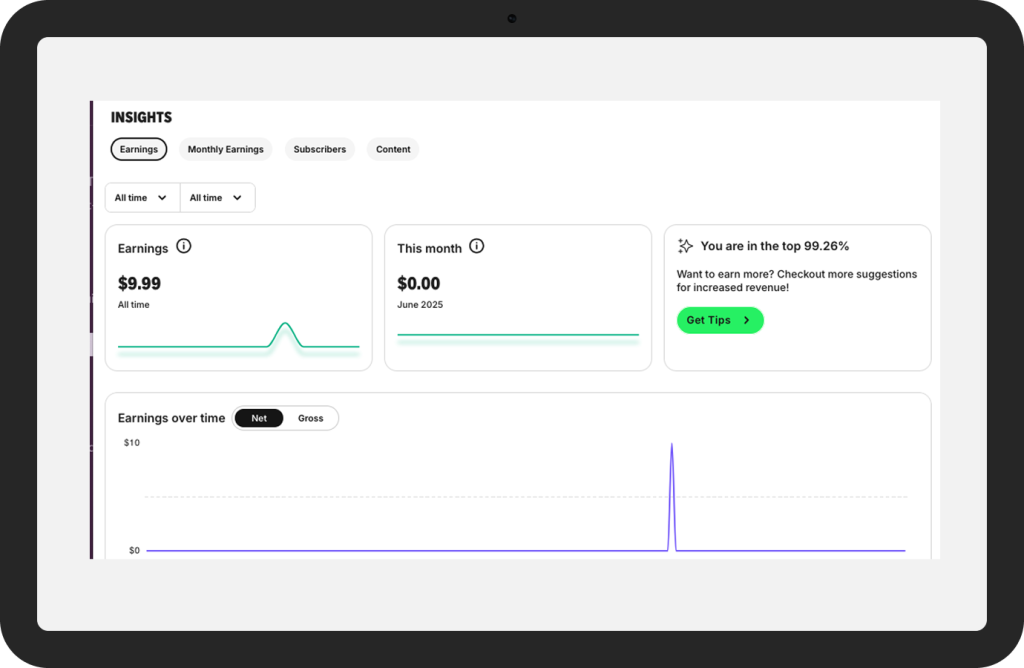
Fanvue’s personalized analytics show exactly how much you earn, as well as the most popular days for earning
- Interface
Time is money. The more hours you spend uploading content, responding to messages, and planning posts, the less time you have to create new content and earn money.
OnlyFans. The interface is outdated and inconvenient. You can schedule posts, but for many tasks you have to use third-party programs.
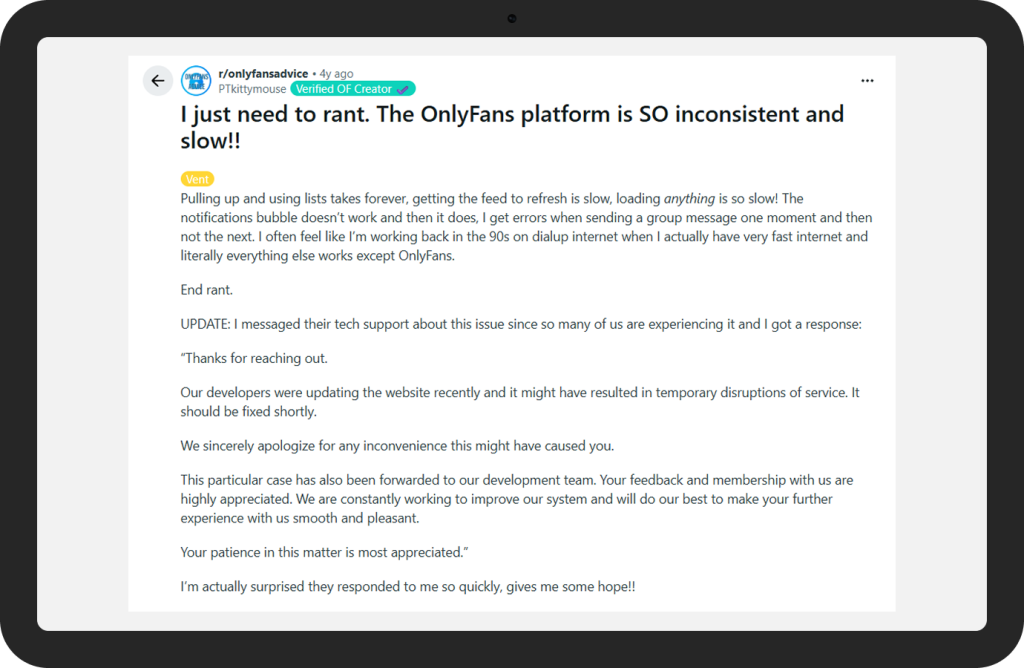
The experience of creators on OnlyFans: not everything works perfectly, but the platform provides feedback and shows a willingness to solve problems
Fanvue. Modern and user-friendly interface. You can upload multiple files at once, schedule posts in advance, and use ready-made templates for messages.
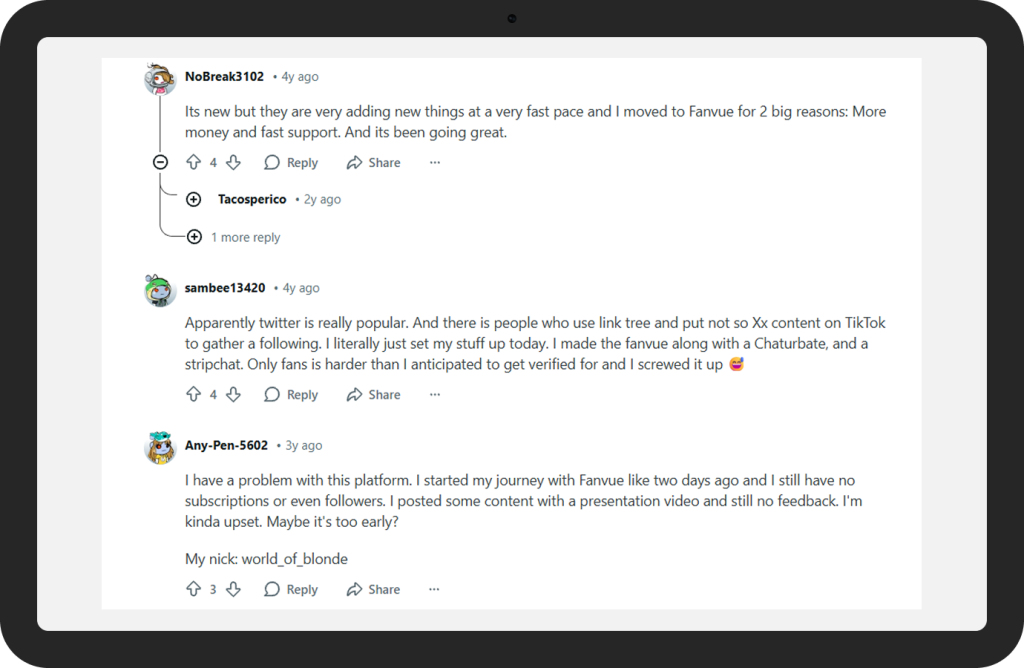
First impressions of working with Fanvue: speed of feature development, monetization, and experience of starting on the platform
- Automation
Onlyfans. There is basic automation: welcome messages to new subscribers, mass mailings, and post scheduling via the built-in scheduler. More complex sales funnels — series of messages, working with different fan groups, behavior-based customization — are usually built using external services and bots.
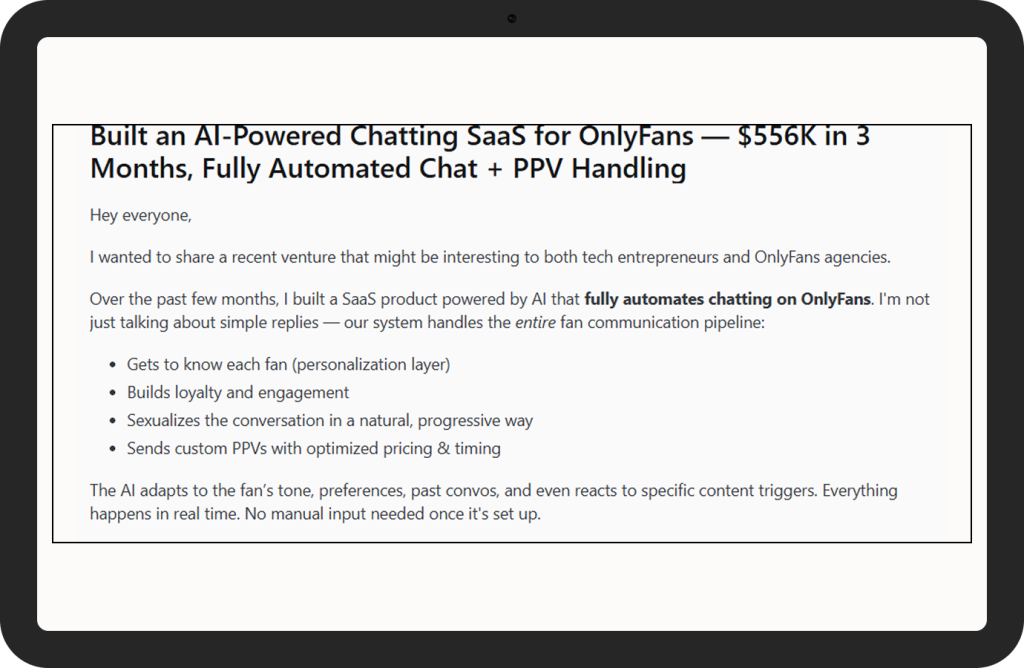
The user created an automated bot using an external tool because they were tired of routine manual actions
Fanvue. The functionality is initially tailored for live work with the database and automation:
- scheduled posts — planning content days and weeks in advance;
- automatic welcome messages for new subscribers;
- response templates for frequently asked questions;
- mass mailings with personalization and integration with chatbots/tools that allow you to build auto-funnels without manual copying.
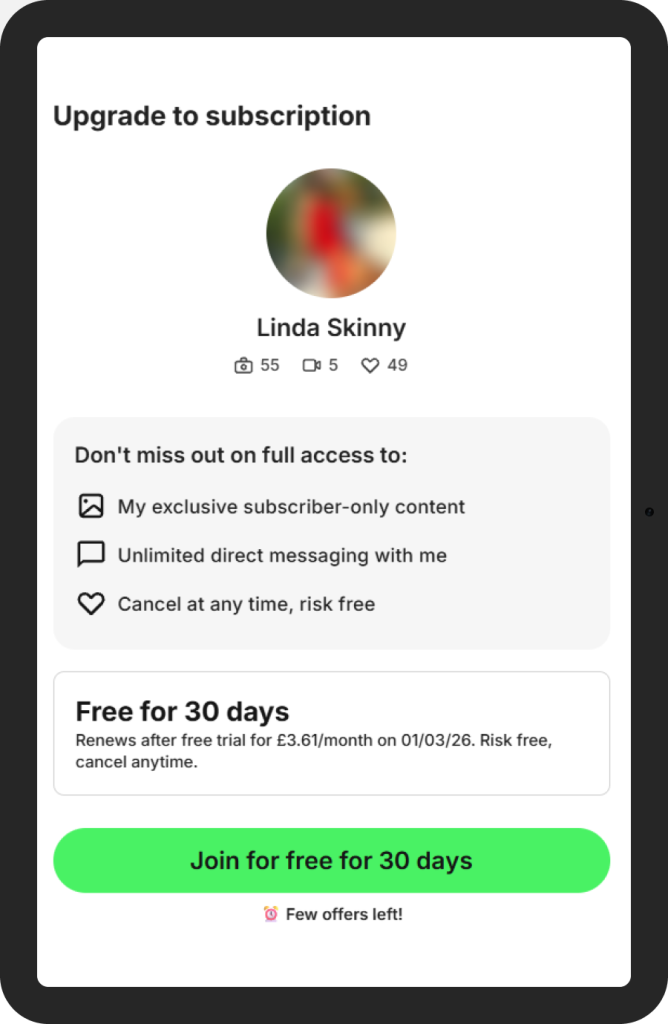
An automatic offer from the model appears immediately after free subscription
- Mobile apps
Both platforms offer mobile apps, but due to App Store and Google Play policy restrictions, some features are limited. This is especially true for anything related to adult content and payment scenarios. For full functionality, authors usually work through the browser version — on a desktop or mobile device in full site mode.
- Interacting with fans: how to build loyalty
Good communication with fans is what turns a one-time subscription into a long-term one. Loyal fans renew for months and regularly purchase additional PPV content.
OnlyFans. There are basic tools: private messages, mass mailings, OF welcome messages. But there is no in-depth work with the audience — you cannot divide fans into groups and find out who spent how much, who has not bought anything for a long time, who often orders custom content. Many creators keep track of all this in Excel spreadsheets or connect third-party programs.
Fanvue. The focus is on working with the fan base. There are filters and groups, message templates, and automatic chains: greetings, reminders, offers. AI suggests who to send what to. This helps build loyalty and sell more without constant manual correspondence.
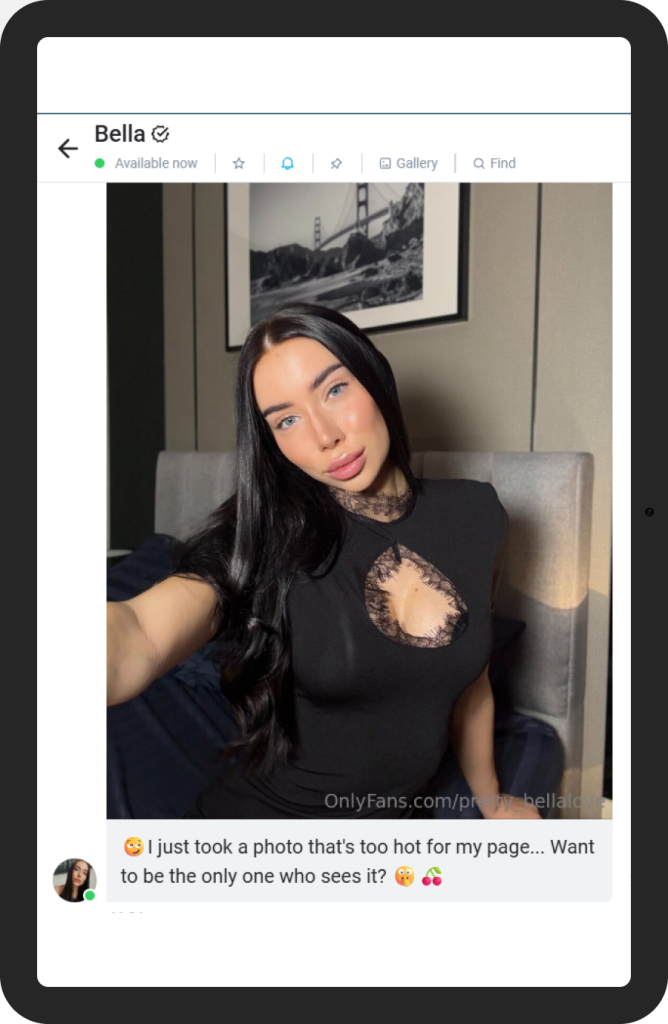 |
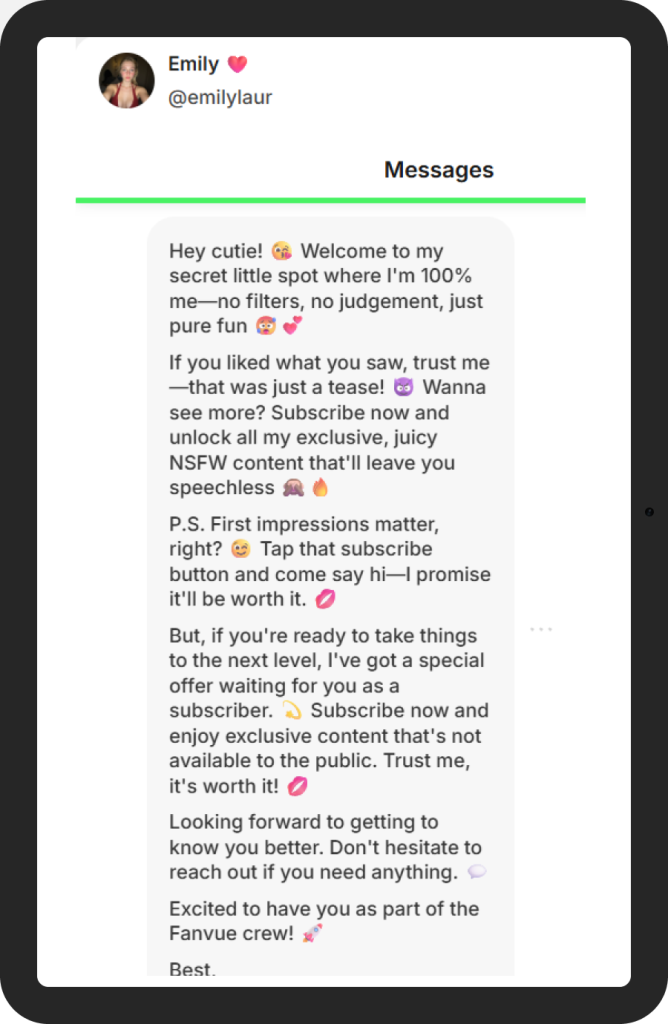 |
|
Examples of model interactions with subscribers on Onlyfans and Fanvue: offering to view a special photo, engaging in correspondence |
- Security and content protection
Content leakage is a direct loss of money. Leaked material loses value, and the creator loses control and risks their reputation.
What both platforms offer:
- two-factor account protection;
- data and payment encryption;
- geo-blocking — you can hide your profile from certain countries;
- privacy settings.
OnlyFans. There is DRM protection for videos: when enabled, new videos are protected from screenshots and screen recording, and watermarks are added. You can file a complaint about pirated copies via the DMCA form, but you need to search for leaks OF content and send complaints yourself or through a separate service.
Fanvue. By default, it places more noticeable watermarks. Supports DMCA complaints. Many creators connect to special anti-piracy services, such as Rulta, which automatically search for leaks on the internet and send removal requests. The platform actively helps creators fight piracy.
The DMCA (Digital Millennium Copyright Act) is a US law that gives you the right to request the removal of your content from any website. You find your leaked material, send a complaint to the site owner, and they are obliged to remove it. Without the DMCA, it would be almost impossible to combat piracy.
The platforms themselves do not search for leaked content on the internet. This is done by the creator themselves — either manually or through special services.
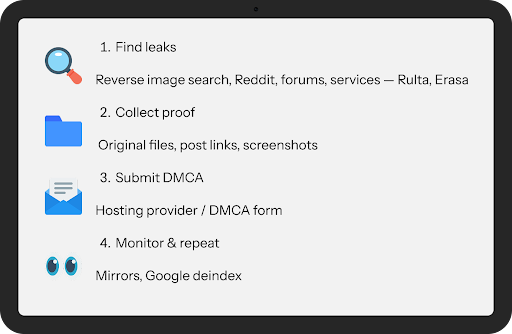
The scheme is similar for all content platforms
- Privacy
On both platforms, you can:
- work under a pseudonym;
- hide your face;
- restrict access by geography;
- make your profile invisible to unregistered users.
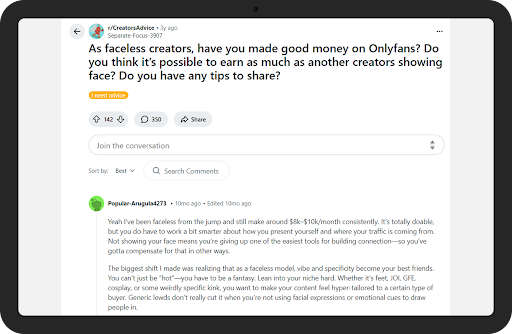
The model shared her experience of how she earns about $8,000 a month anonymously — without showing her face
- Creator support
When problems arise — blocking, payment delays, bugs — speed of assistance is important.
OnlyFans. Support works via email. They usually respond within 24-72 hours. Complex issues — such as bans or payment problems — can take 5-7 days to resolve. Responses are often formulaic, and sometimes you have to write several times.
Fanvue. There is email and live chat for verified creators. They usually respond within a few hours. The approach is more personal, especially for large creators and AI models. Problems are examined in detail, rather than simply sending links to FAQs.
- Training resources
OnlyFans. There is a basic help center and a blog with instructions. There are almost no advanced training programs on strategy and marketing. Creators learn from third-party blogs, Reddit, and unofficial courses.
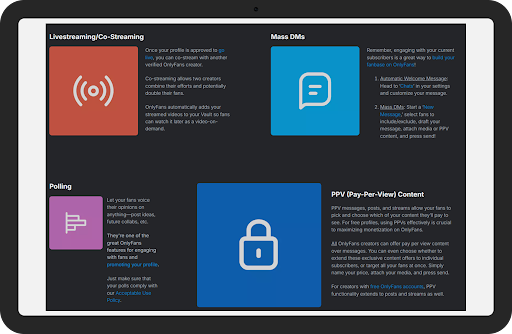
The OnlyFans blog only helps you understand the basic settings.
Fanvue. A large knowledge base, a blog with practical examples, guides on the Discover system and AI tools. They conduct video reviews and webinars for beginners. They have their own community of creators. This provides more official information and less dependence on questionable courses.
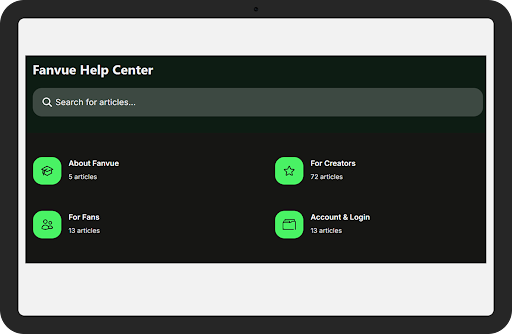
The Fanvue help center contains over 70 practical articles for content creators
Which platform to choose: a decision-making guide
The choice of platform depends on your current audience, goals, and content experience. There is no one-size-fits-all solution — there is only the one that suits your situation.
- You already have a large audience (10,000+ active subscribers).
- You are confident that you can convert at least 1–2% of external subscribers (Instagram 50,000+, TikTok 100,000+).
- OnlyFans’ brand recognition will work for you: fans trust the platform and are easier to convert.
- You are an experienced marketer or SMM professional who knows how to attract traffic without the platform’s internal tools.
- The priority is a stable and proven infrastructure: OnlyFans has been operating since 2016 and has survived all the crises in the industry.
The typical path of a successful creator with a large audience:
| 50,000+ Instagram followers ➡️ launch OnlyFans with active promotion ➡️ conversion of 1-2% of the audience (500-1,000 paying fans) ➡️ at an average price of $15/month, this generates $7,500-15,000 in revenue ($6,000-12,000 after commission) in the first month. OnlyFans’ brand recognition lowers the barrier — fans already know the platform and trust the payment process. |
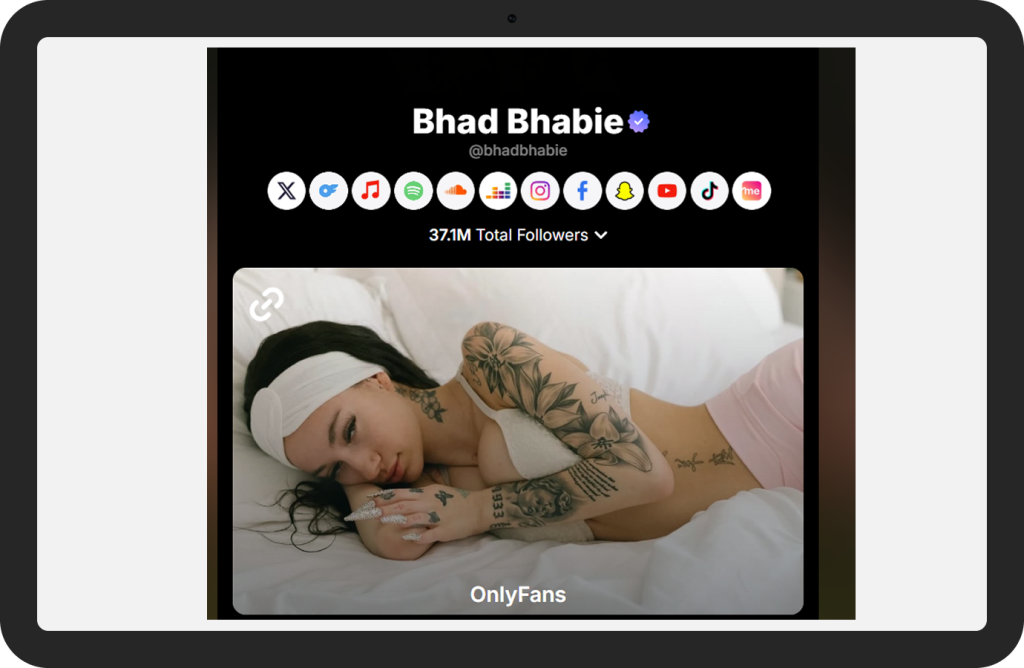
Rap artist Bhad Bhabie has over 37 million followers across all platforms. OnlyFans has already brought her about $75 million in revenue
Choose Fanvue if:
- You are starting from scratch or have a small audience (fewer than 5,000 followers).
- The Discover system is its main asset. Even without external subscribers, you can grow organically.
- The priority is to maximize income at the beginning of your journey: 15% commission in the first 30 days instead of 20% and fast payments.
- You value modern tools and automation: scheduling, message templates, analytics.
- It’s important to get real support: fast live chat and personalized responses.
A typical scenario for a beginner without an existing audience:
| month 1 ➡️ 20-50 subscribers (mainly through Discover), month 2 ➡️ 80-150 subscribers (the algorithm has started to actively recommend the profile), month 3 ➡️ 200-350 subscribers. With an average price of $12/month and active PPV sales, this brings in $1,500–$4,000 in revenue by the third month. On OnlyFans, without a ready-made audience on social media, it is almost impossible to achieve such results. |
Some creators work with two platforms at once, dividing their tasks. One is used as the main source of income with an already established audience, the second is for testing formats, tools, and new growth channels. This approach reduces dependence on a single platform and provides more flexibility.
When it makes sense:
- Income is already stable (approximately $10,000 per month) and there are resources to support two platforms.
- There is a desire to test Fanvue without giving up the existing audience on OnlyFans.
- Content is logically divided by format or purpose, rather than duplicated entirely.
Practical guide: how to get started on your chosen platform
Day 1: Setup
- Verification on OnlyFans (ID, selfie — takes from hours to 2-3 days)
- Profile: username, bio, avatar, price $9.99–$14.99
- Security: 2FA, password, geo-blocking, DRM
- Payments: card, limits
Day 2: Content
- Upload 10–15 most interesting posts on OF before the announcement
- Mix of photos/videos, from tease to explicit
- On Fanvue: schedule a week in advance
Top 5 mistakes made by beginners
- Incorrect price: $50 — no one will buy it, $3.99 — cheap audience. Start: $9.99-$14.99
- Inconsistency: Better to have 3 posts a week consistently than chaos
- Ignoring analytics: Look at the top 3 posts weekly, do something similar
- No PPV funnel: Day 3 — PPV for new subscribers, weekly — for the entire base
- Relying solely on Discover: You need external traffic (Instagram, Reddit)
When to change platforms
Here are scenarios when it’s justified:
OnlyFans → Fanvue:
- You’ve grown to $2-3k/month on OnlyFans, but growth has stalled.
- You’ve exhausted your external audience and need a new source of traffic.
- You’re tired of the routine and want automation.
- The 5% commission savings in the first year becomes significant.
- Risks: loss of some fans who don’t want to switch.
Fanvue → OnlyFans:
- You are a top creator ($10k+/month), and OnlyFans’ brand recognition will open up new opportunities — OF collaborations, media.
- Fanvue does not provide the desired audience scale.
- You want to consolidate everything in one place under the most recognizable brand.
- Risks: loss of Fanvue advantages — discovery, commission, UX.
How to transfer your audience without losses:
- Announce the move 2-4 weeks in advance.
- Offer a special price on the new platform for current fans.
- Support both platforms in parallel for 1 month.
- Provide exclusive content on the new platform to encourage the transition.
- Expect to lose 20-30% of your audience during migration.
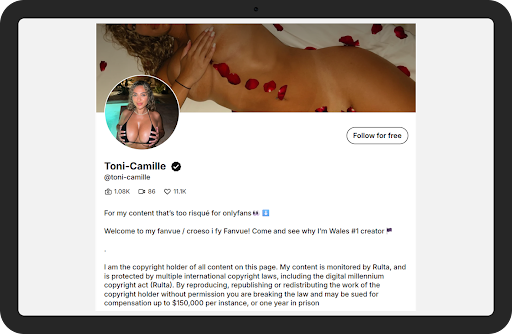
Model Toni-Camille switched platforms after OnlyFans attempted to ban adult content and earnedabout $40,000 in the first 3 weeks
How to make a decision
Let’s look at the comparison table.
| Parameter | OnlyFans | Fanvue |
| Commission | 20% | First 30 days — 15%, then 20% |
| Payouts | 7–10 days | 24 hours |
| Discovery | ❌ No | ✅ Yes (AI recommendations) |
| Scheduling | ❌ No | ✅ Yes |
| Auto-messages | ❌ No | ✅ Yes |
| Analytics | Basic | Advanced |
| UI/UX | Outdated | Modern |
| Support | Slow | Fast |
| Brand recognition | ⭐⭐⭐⭐⭐ | ⭐⭐⭐ |
| Launch year | 2016 | 2020 |
| Barrier to entry | High (existing audience needed) | Low |
Conclusions
- The wrong platform can block growth or lead to a 20-30% loss in revenue.
- OnlyFans is for experienced and recognizable creators. It is suitable for those who already have a large audience and external traffic.
- Fanvue is for beginners and creators focused on growth. Suitable for those who are starting from scratch or want to quickly scale their audience within the platform.
- You can work on two platforms for different types of content or to diversify risks.
- When switching between platforms, it is important to notify fans in advance, use exclusive content, and support both platforms in parallel for 1 month.
Author

Want more paying OnlyFans subscribers?

Launch a campaign in 24 hours and fill your creators’ pages with real fans, not freebie hunters.
Recent partner average: $4.24 back per $1 spent • 324% ROMI
Real people only. No bots, no spam traffic sources.
ONLY FOR ONLYFANS AGENCIES, MODELS, AND MARKETERS
Want to promote your OnlyFans profile?
Start getting paying subscribers from search. Launch in 48 hours.
Recent partner average: $4.24 back per $1 • 324% ROMI